
NHS pre-employment checks: the six standards explained
The six checks every NHS appointment needs, what each one involves, and where the time usually goes.

What are the NHS pre-employment checks?
NHS pre-employment checks are the six NHS Employment Check Standards set by NHS Employers: identity checks, right to work checks, employment history and reference checks, criminal record checks, professional registration and qualification checks, and work health assessments. They apply to all NHS appointments in England, including temporary, agency and volunteer roles. RefAssure handles the employment history and reference part.
The six NHS Employment Check Standards.
NHS Employers publishes the standards for NHS organisations in England. Agencies and other providers supplying NHS staff are expected to meet them too.
1. Identity checks
Confirm the person is who they say they are, using original documents or a certified digital identity check.
2. Right to work checks
Confirm the person can legally work in the UK, following Home Office guidance. See right to work checks.
3. Employment history and references
Verify employment history and obtain references. RefAssure handles this one.
4. Criminal record checks
A DBS check at the level the role is eligible for, with barred list checks where needed. See the DBS checks guide.
5. Professional registration and qualifications
Check the register for regulated roles, such as the NMC, GMC or HCPC, and verify qualifications the role needs.
6. Work health assessments
Assess whether the person is fit for the role, with reasonable adjustments considered, usually through occupational health.
The employment history and reference checks standard
This standard often holds up a start date, because it depends on other people replying. The key points:
- The application should capture a full employment history, with gaps explained and explored at interview.
- For new appointments from outside the NHS, employers should obtain references that validate three consecutive years of employment or training immediately before the application.
- The number of references depends on the person's history. Someone with one employer for three years may need one; someone with several short roles will need more.
- Someone moving from another NHS organisation should, at minimum, have a reference from their current or most recent NHS employer.
Our NHS reference requirements page covers the standard in full. In Scotland, Wales and Northern Ireland, health bodies follow their own guidance, which is broadly similar.
Volunteers are a special case. A change to the rules in January 2024 removed the statutory requirement for a full employment history for volunteers, but NHS Employers still expects references to be sought.

Take the waiting out of standard three.
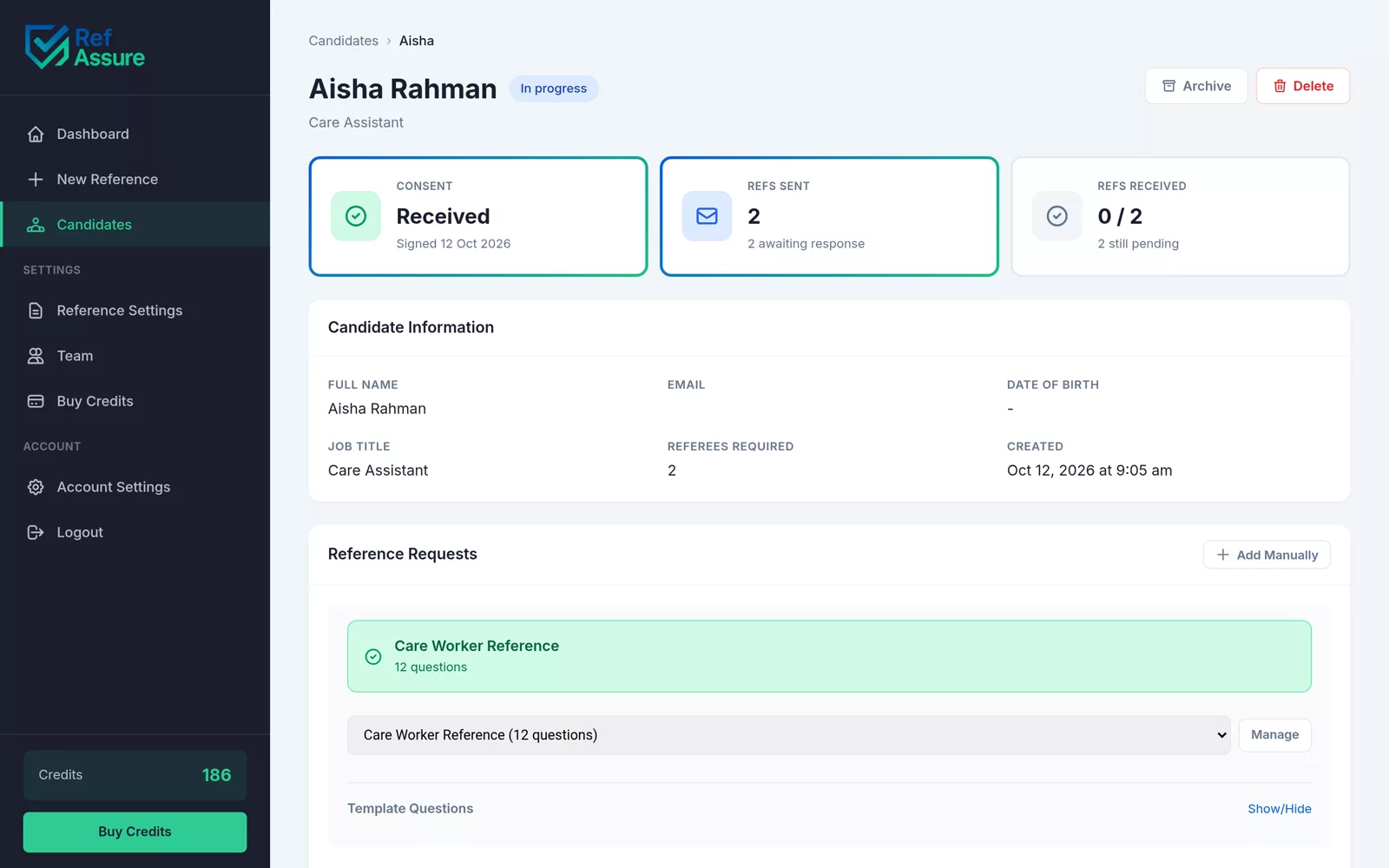
RefAssure sends reference requests in minutes, collects consent and chases referees by email and text until they reply.
- Candidate consent collected online, with signature, before referees are contacted
- 5 emails and up to 2 texts over 12 days, stopping the moment the referee submits
- Bounced emails flagged, usually within minutes, so you can ask for a new address
- Signed PDF with timestamps for consent, requests, reminders and completion
How long do NHS pre-employment checks take?
NHS Employers does not set a timescale, and it varies a great deal by role and organisation. The checks run in parallel, so the slowest one sets the start date. The usual culprits are:
- References. Referees who are on leave, have moved on or simply do not reply.
- DBS checks. Processing times vary, especially where several police forces are involved.
- Occupational health. Appointments and vaccination records.
- Overseas history. Overseas criminal record certificates and references from abroad take longer.
- Registration. New registrants and people joining from overseas may still be waiting for their regulator to confirm registration.
A few habits help across the board: start checks as soon as a conditional offer is made, ask candidates for complete referee details including a work email and mobile number, and tell candidates which documents to bring to their identity and right to work check.
References are the part you can speed up. Across 229 references completed through RefAssure, the median was about 23 hours, half came back within 24 hours, and 4 in 10 were completed after an automatic reminder.
NHS pre-employment check questions
More in the full FAQs.
Do the six standards apply to agency and bank staff?
Yes. NHS Employers says the standards apply to all NHS appointments, including temporary and agency staff, students, volunteers and contractors. Agencies on NHS frameworks are audited against them. See NHS framework reference compliance.
How many references does the NHS need?
There is no fixed number. The references must together validate three consecutive years of employment or training before the application.
Can someone start before all checks are complete?
NHS Employers expects checks to be completed before a person starts. Any exception should follow the organisation's own risk assessment process, so ask your HR team.
Does RefAssure do all six checks?
No. RefAssure handles employment history and references. Identity, right to work, DBS, registration and occupational health checks go through the official services and your own processes. See occupational health checks.
How long do NHS pre-employment checks take?
It varies by role and organisation, and the slowest check sets the start date. Automated reference chasing removes one common delay.
What does RefAssure cost?
Your first reference is free. Then credits run from 99p to 80p each, with no monthly fee and no VAT added. See pricing.
Do the NHS Employment Check Standards apply in Scotland and Wales?
The standards published by NHS Employers are for NHS organisations in England. NHS Scotland, NHS Wales and Health and Social Care in Northern Ireland set their own pre-employment check guidance, covering similar ground.
Related guides
Clear the reference check first.
Your first reference is free. Two minutes to send, and RefAssure does the chasing.