
DBS checks for employers: basic, standard and enhanced.
Which level a role qualifies for, what each certificate shows, how the Update Service works, and the half of safer recruitment a DBS check cannot cover.

How does a DBS check for employers work?
A DBS check is a criminal record check from the Disclosure and Barring Service. There are three levels: basic (unspent convictions, any role), standard (spent and unspent records, subject to filtering, for eligible roles) and enhanced (standard plus relevant police information, and barred lists for regulated activity). The role decides the level, not the employer. A DBS check does not replace references.
The rule employers get wrong: the role sets the level
Employers cannot pick a DBS level because it feels safer. A basic check can be requested for any job. Standard and enhanced checks are lawful for roles that are eligible under legislation: broadly, roles listed in the exceptions to the Rehabilitation of Offenders Act 1974 and, for enhanced checks, roles such as working with children or adults who need care and support.
Asking for a higher level than the role allows is not "belt and braces". The application can be refused, and asking for information the role is not eligible for can put you in breach of the rules. If a role does not qualify for standard or enhanced, the right route is a basic check plus thorough written references.
If you are unsure, the DBS publishes an eligibility tool and guidance on GOV.UK, and a registered body or umbrella body can advise you before you apply.
The three types of DBS check, side by side.
Each level shows more, and each is open to fewer roles.
Basic DBS check
Shows unspent convictions and conditional cautions. Available for any role. Individuals can apply for their own on GOV.UK, or an employer can request one through a Responsible Organisation.
Standard DBS check
Shows spent and unspent convictions, cautions, reprimands and final warnings, subject to filtering rules. For eligible roles such as certain legal, financial and security jobs. Applied for through a registered body.
Enhanced DBS check
Everything on a standard check plus relevant information held by local police. Where the role is regulated activity, it can include the children's and adults' barred lists. Common in care, schools and healthcare.

DBS check levels: choosing the right one for the role
Start from the job description
Look at what the person will actually do, how often, and with whom. A receptionist in an office qualifies for a basic check. A care worker giving personal care, a teacher, or a nurse will usually qualify for an enhanced check. Some roles in finance, law and security sit in between and qualify for standard.
Barred list checks
The barred lists record people the DBS has decided must not work in regulated activity with children, adults, or both. A barred list check is part of an enhanced check and is available where the role is regulated activity. Employing a barred person in regulated activity is a criminal offence. For care roles, our care worker safeguarding checks guide covers barred list checks in detail.
How to apply
For standard and enhanced checks, the applicant fills in the application and provides identity documents, and the employer (or a registered or umbrella body acting for it) checks those documents and submits the application. The certificate is sent to the applicant, not the employer, so build in a step to see the original.
Recruiting people with a criminal record
A record on a certificate is not an automatic bar to employment. DBS's code of practice expects organisations using standard and enhanced checks to have a written policy on recruiting people with criminal records, and to discuss anything relevant with the applicant before deciding. Treat each case on its facts and its relevance to the role.
Why a DBS check does not replace references.
| DBS check | References | |
|---|---|---|
| What it shows | Criminal record information and, where eligible, barred list status | Employment history, conduct, performance and suitability for the role |
| Dismissal for misconduct | Not shown unless it led to police involvement | A referee can confirm it and give the reason |
| Safeguarding concerns | Shown if police or DBS hold relevant information | A previous employer can describe concerns that never reached the police |
| Dates and gaps | Not covered | Dates confirmed by each employer, gaps explored |
| Who runs it | DBS, through the applicant and a registered body | You, with the candidate's consent. RefAssure automates it |
Does a DBS check expire? The Update Service and rechecks
A DBS certificate has no official expiry date. It shows what was recorded on the day it was issued and says nothing about what happened afterwards. So the useful question is not "is it valid?" but "is it recent enough for this role, and what is our rechecking policy?" Regulated employers should be able to answer that in writing.
How the Update Service works
The applicant can subscribe to the DBS Update Service for an annual fee, joining when they apply or shortly after the certificate is issued (GOV.UK sets out the time limit). With their consent, you can then run a free online status check to see whether the information on their certificate is still current. If the status shows new information, you will need a new check.
When to ask for a new certificate
- The candidate is not on the Update Service and their certificate is old, issued for a different workforce, or at the wrong level.
- The status check shows the certificate is no longer current.
- Your own policy or a regulator's guidance says to recheck at set intervals.
Run the DBS and references at the same time.
DBS timing is out of your hands. References do not have to be. Send them the day you make the offer.
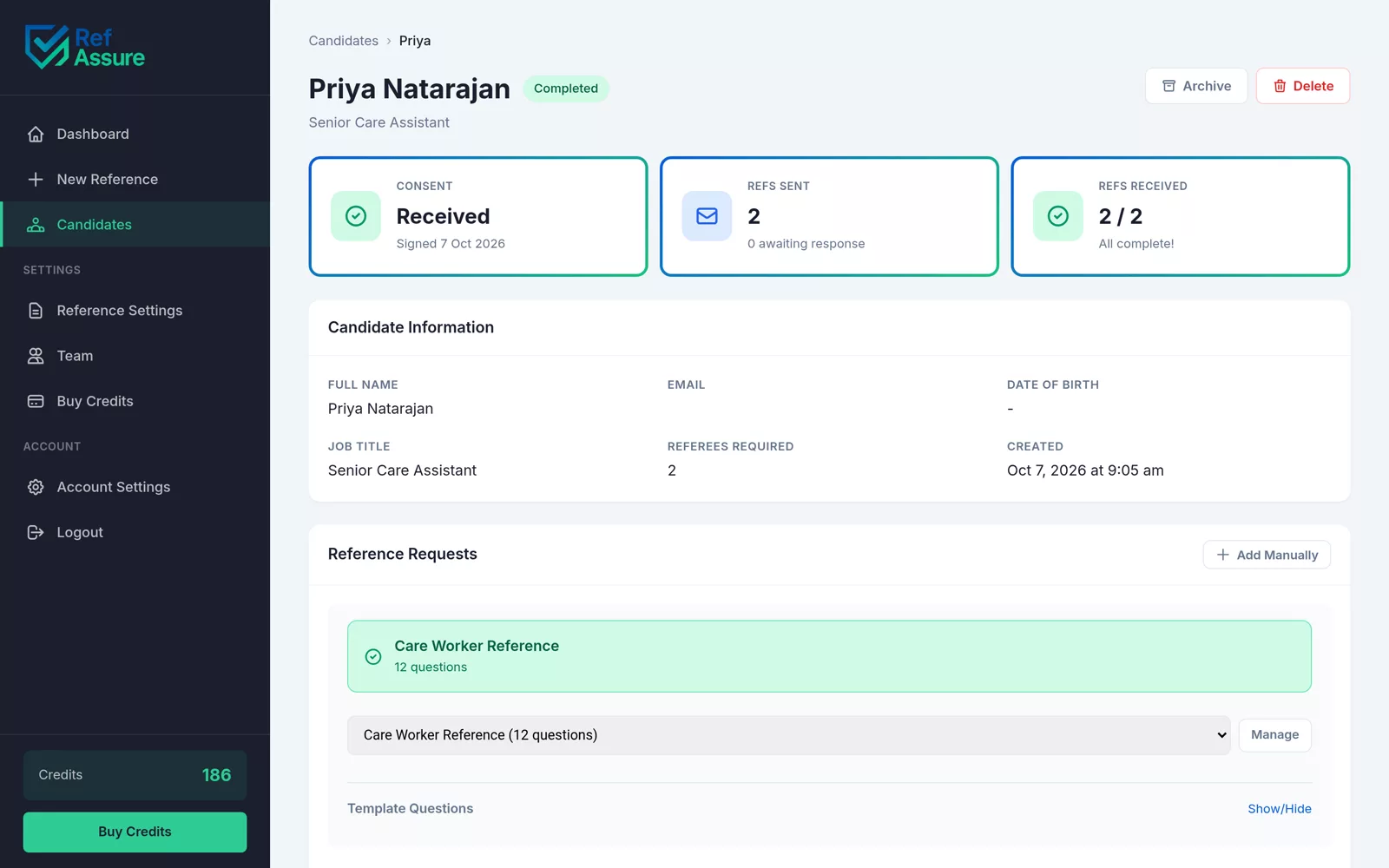
- Candidate consent collected online, with signature, before referees are contacted
- 5 emails and up to 2 texts over 12 days, stopping when the referee replies
- Median about 23 hours across 229 completed references
- Signed PDF with a full audit trail, ready for the staff file
DBS check questions
More in the full FAQs.
Can an employer DBS check any employee?
An employer can ask for a basic check for any role. Standard and enhanced checks are allowed for eligible roles. Asking for a higher level than the role qualifies for is not allowed.
What is the difference between a standard and an enhanced DBS check?
A standard check shows spent and unspent convictions, cautions, reprimands and final warnings, subject to filtering. An enhanced check adds relevant local police information and, for regulated activity, can include barred list checks.
How long does a DBS check take?
It varies. Enhanced checks can take longer because local police forces may be asked for information. Because the timing is outside your control, start references at the same time rather than waiting for the certificate.
Who pays for a DBS check?
There is no rule. Many employers pay, some ask the candidate to, and volunteers can get free standard and enhanced checks. Current fees are on GOV.UK.
Is a DBS check from a previous employer acceptable?
It can be, if the level and workforce match the new role and you can confirm it is current, usually through the Update Service. Otherwise apply for a new one. Your policy should say which you accept.
Do I still need references if the DBS is clear?
Yes. Most reasons someone is unsuitable never reach a police record. In care, Schedule 3 requires references alongside the DBS, and KCSIE Part 3 sets the same expectation for schools. See DBS vs references in care and DBS vs references in schools.
Does RefAssure do DBS checks?
No. DBS checks go through the DBS and a registered body. RefAssure collects the references and employment history that sit alongside them, from 80p each with your first reference free. See pricing.
What other pre-employment checks are there?
Right to work, references, employment history and, for some roles, qualifications and professional registration. Our guide to pre-employment checks explains each one and how long they take.
Related guides
DBS in progress? Get the references done.
Your first reference is free. RefAssure collects consent, chases referees and files a signed PDF.