
Is a DBS check enough, or do care staff still need references?
A clear DBS is good news. It is not the whole story, and CQC's rules expect you to know the rest.

Is a DBS check enough without references in care?
No. A DBS check shows criminal records and, where requested, whether someone is barred. It cannot show how they behaved at work, concerns an employer handled internally, or why they left. CQC Schedule 3 asks for both an enhanced DBS check and evidence of conduct in previous care roles, so care and health providers need references as well.
DBS vs references: what each one shows.
| Enhanced DBS check | Reference | |
|---|---|---|
| Convictions and cautions | Yes, spent and unspent, subject to filtering rules | Not reliably |
| Barred list status | Yes, where the role is eligible and the list is requested | No |
| Local police information | Sometimes, if the police judge it relevant | No |
| Conduct with people supported | No | Yes, ask directly |
| Disciplinary or safeguarding processes handled internally | Not unless they led to a conviction or barring | Yes, ask directly |
| Why the person left | No | Yes, ask the referee to confirm it |
| Reliability and attendance | No | Yes |
Why care providers need both
The DBS discloses what reached the criminal justice system or a barring decision. A great deal of what matters in care never gets that far. A care worker dismissed for rough handling, poor medication practice or crossing boundaries may have a completely clear certificate if the matter was dealt with by the employer.
That is why Schedule 3 of the 2014 Regulations, which sits behind CQC Regulation 19, lists them as separate items. It asks for an enhanced DBS certificate with barred list information where applicable, and also for satisfactory evidence of conduct in previous care roles and verification of why those roles ended. One does not stand in for the other.
Is it different in healthcare?
No. The same rule applies to every CQC-registered provider, including GP practices, dental practices and clinics. For registered professionals you also check the regulator's register, but a clean register entry, like a clear DBS, does not tell you how someone worked day to day.
Which should you start first?
Start references as early as you can, ideally at shortlisting with the candidate's consent. Answers then arrive in time to discuss at interview. The enhanced DBS application usually follows a conditional offer. Both need to be in place before the start date. Our DBS checks guide covers levels and timing.

The half the DBS cannot see.
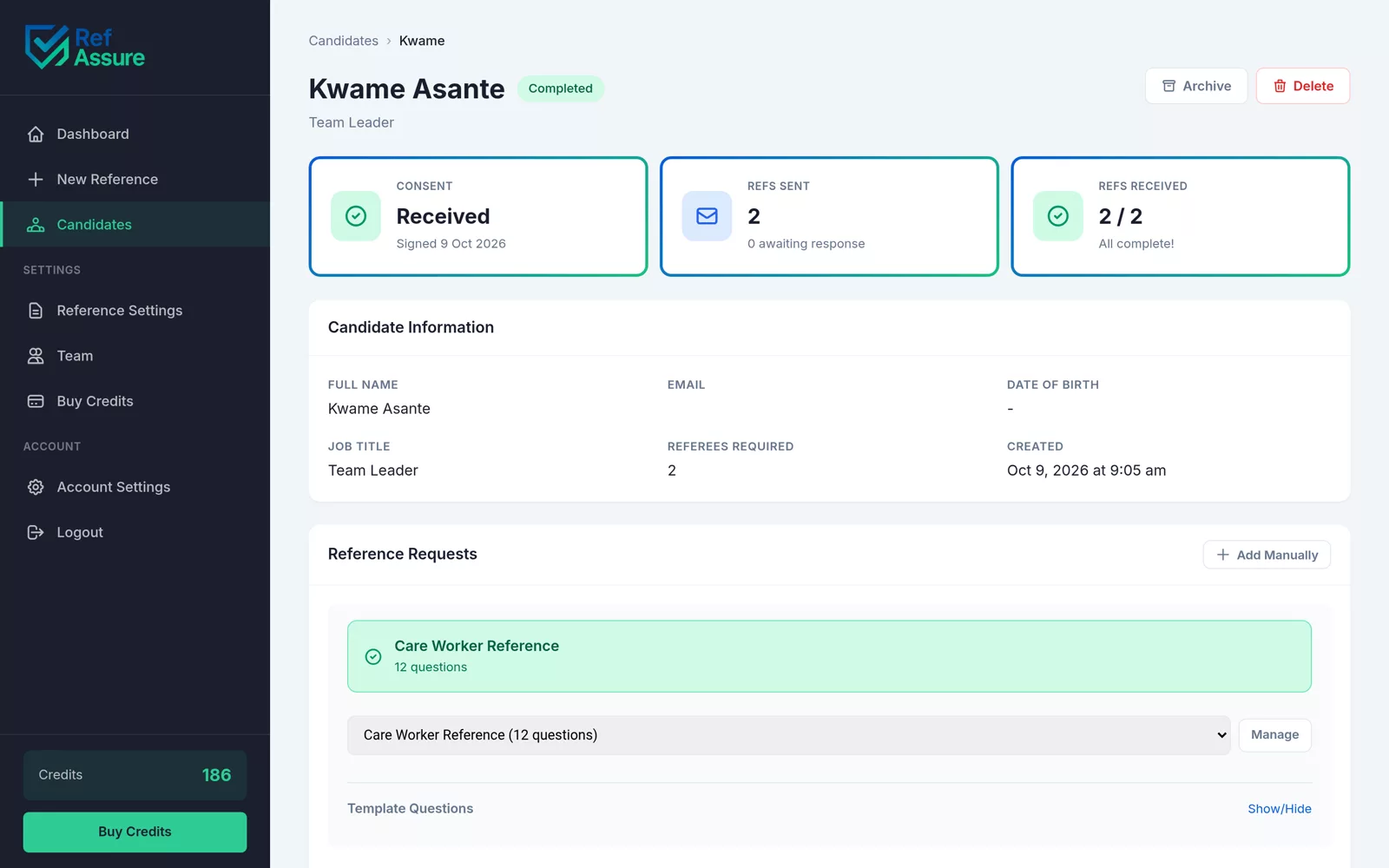
RefAssure collects the conduct evidence. You add your questions once, and every referee answers them in writing and signs.
- Online consent from the candidate, with a signature, before referees are contacted
- 5 emails and up to 2 texts over 12 days, stopping when the referee replies
- Replies sent by email instead of the form are captured and forwarded
- A signed PDF with a full audit trail for the staff file
DBS and reference questions
More in the full FAQs.
Can references replace a DBS check in care?
Can a care worker with a clear DBS still be unsuitable?
Does a DBS check count as a reference?
What should a care reference ask that a DBS cannot answer?
Does RefAssure do DBS checks?
Related guides
Get the half of the check a DBS cannot do.
Your first reference is free. Two minutes to send, then RefAssure chases.