
What pre-employment checks does a care worker need?
The full checklist for CQC-registered providers, the order to run it in, and the part RefAssure takes off your desk.

In England, CQC-registered providers must hold the Schedule 3 information before a care worker starts: photo ID, an enhanced DBS check with barred list where the role is eligible, evidence of conduct in previous care roles, why earlier care jobs ended, relevant qualifications, a full employment history with gaps explained in writing, and relevant health information. Right to work is checked separately under immigration law.
The care worker pre-employment checklist.
Care worker pre employment checks come from Schedule 3 of the 2014 Regulations, which sits behind CQC Regulation 19. Here is each item in plain words.
Proof of identity
A current photo ID, checked against the person in front of you, with a recent photograph kept on file.
DBS and barred list
An enhanced DBS certificate, with the adults or children barred list check where the role is regulated activity. See our DBS checks guide.
Conduct in previous care roles
Satisfactory evidence of how the person behaved in earlier work in health or social care, or with children or vulnerable adults. In practice, this means references.
Why care jobs ended
Where someone worked with children or vulnerable adults before, verify why that job ended, so far as reasonably practicable.
Full employment history
Every job from leaving education, with a satisfactory written explanation of any gaps. A CV with missing years is not enough.
Qualifications and health
Documentary evidence of relevant qualifications where practicable, and information about any health condition relevant to the role after reasonable adjustments.
What order should the checks happen in?
Nothing in Schedule 3 sets a strict sequence, but CQC guidance says the information must be confirmed before the person is employed. A sensible order keeps your start date safe:
- At application: collect the full employment history and ask the candidate to explain any gaps in writing. Get consent and send reference requests as early as you can, because referees are the part you cannot control.
- At interview: talk through gaps and reasons for leaving. Check original ID, qualifications and right to work documents. The Home Office sets out how to do a right to work check.
- After a conditional offer: apply for the enhanced DBS check and gather health information. The Equality Act 2010 limits health questions before an offer, so this usually comes later.
- Before day one: review the whole file. Every item should be in place, dated and signed off by the person making the decision.
Do bank and agency staff need the same checks?
Yes. CQC guidance says a "person employed" includes volunteers, contractors, and agency or bank staff. If an agency carries out the checks for you, you still need to confirm they are complete and satisfactory. Our bank staff references guide covers how providers handle this.
What about professional registration?
Nurses and other registered professionals working in care must hold current registration with their regulator. You check this on the regulator's own online register, such as the NMC register for nurses.

The references part, done for you.
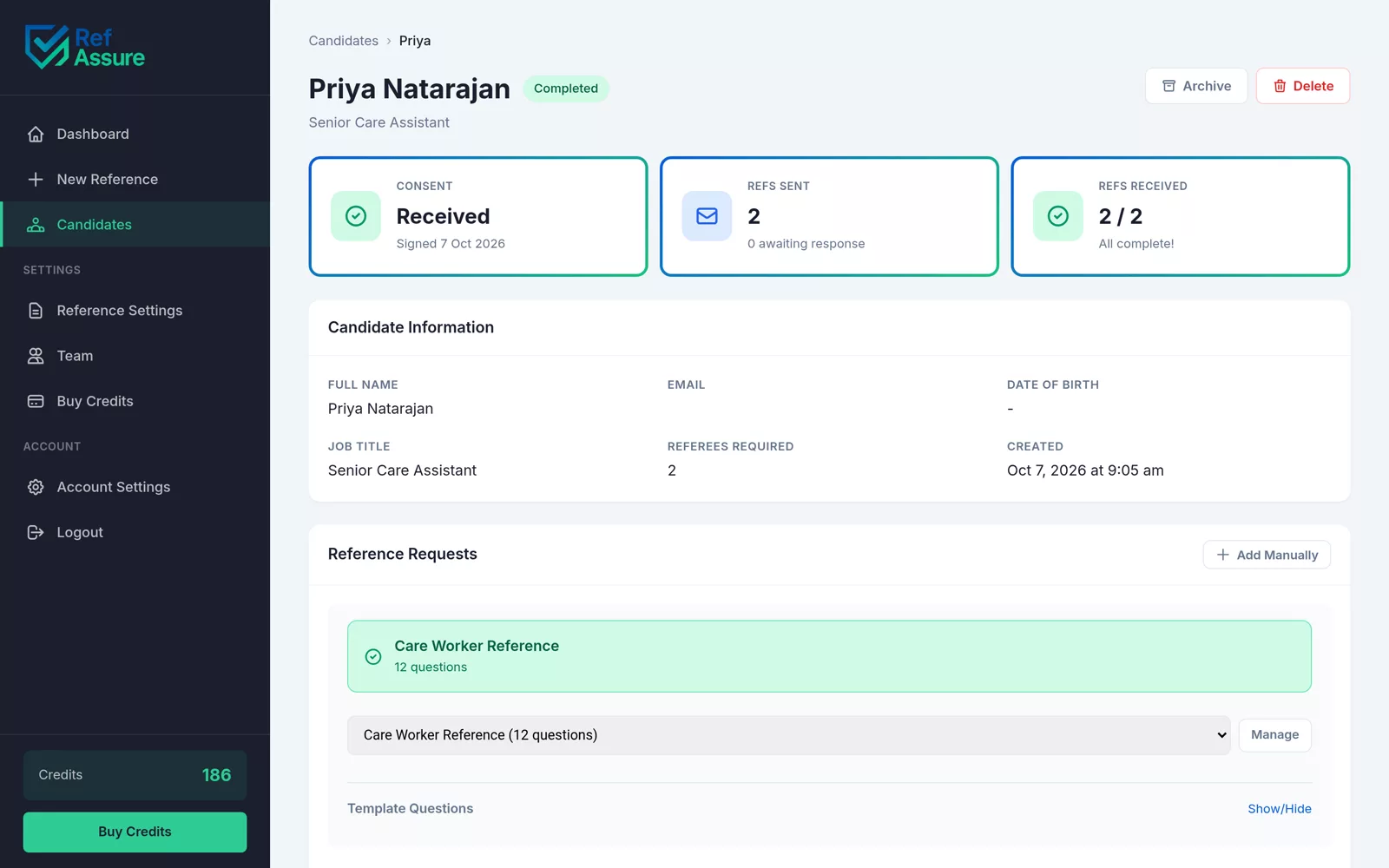
References and employment history are the checks that drag. RefAssure collects consent, contacts each referee and files the signed result.
- Candidate gives consent online, with a signature, before any referee is contacted
- Referees answer on a secure link, no login, on any device, and sign the reference
- Add your conduct, safeguarding and reason for leaving questions to your template once
- A PDF report with timestamps for consent, requests, reminders and completion
Chased for you, day by day.
5 emails and up to 2 texts over 12 days, stopping the moment the referee replies.
Care worker check questions
More in the full FAQs.
Can a care worker start before all the checks are back?
How many references does a care worker need?
Is a DBS check enough on its own?
How far back should the employment history go?
Does RefAssure do DBS or right to work checks?
Where does Regulation 19 fit in?
Related guides
Clear the hardest check off the list.
Your first reference is free. Send it in two minutes and RefAssure chases for you.