
Reference checking for care agencies, ready for CQC
Written evidence of conduct from previous care roles, chased automatically and filed with a signed audit trail you can show an inspector.

What are the CQC reference requirements?
Under Regulation 19 and Schedule 3, CQC-registered providers must hold satisfactory evidence of a worker's conduct in previous employment in health or social care, or with children or vulnerable adults, and verify as far as reasonably practicable why that work ended. RefAssure collects that evidence in writing, chases referees automatically and files a signed, timestamped report. From 80p a reference, and your first one is free.
What CQC expects from your references.
Safe recruitment in social care rests on a few clear requirements. Here is what they mean for the references you collect.
What does Schedule 3 ask for?
Regulation 19 of the Health and Social Care Act 2008 (Regulated Activities) Regulations 2014 says the people you employ must be fit and proper for the work. Schedule 3 lists the information you must hold for each of them. Three items shape your references:
- Satisfactory evidence of conduct in previous employment concerned with health or social care, or with children or vulnerable adults.
- Verification of why that employment ended, so far as reasonably practicable, where the role involved work with children or vulnerable adults.
- A full employment history with a written explanation of any gaps. Referees can confirm the dates the candidate gives you.
Does it cover agency and bank staff?
Yes. CQC's guidance says "person employed" includes agency and bank staff, volunteers and contractors. Where an agency carries out the checks, the provider must still be assured they are complete. That is why care agencies are often asked to show the evidence behind every worker they place, not just a tick on a list.
When must the checks be done?
CQC expects the Schedule 3 information to be confirmed before a person is employed. In domiciliary care, where new starters often work alone in people's homes, a slow reference is a real gap. Read the regulation and guidance in full on the CQC Regulation 19 page.
RefAssure does not replace your own recruitment policy. It helps you meet these requirements by collecting the evidence in writing and keeping a record of how you got it.
Questions to ask care referees.
References for care workers need more than dates. Add these to your template once and every request asks them.
Dates, role and duties
When did they work for you, in what role, and what care did they give? This checks the history on their application.
Why did the employment end?
Schedule 3 asks you to verify this for roles with children or vulnerable adults. Ask it directly, as a short text answer.
Conduct with the people they supported
A 1 to 10 rating for dignity, respect and kindness, with room for a comment.
Any safeguarding concerns?
Were they the subject of any safeguarding concern or investigation? A yes or no, with details if yes.
Disciplinary action
Any warnings or disciplinary action during their employment? Ask for the outcome as well as the fact.
Would you re-employ them in care?
A simple yes or no that often tells you more than a paragraph.
Already have a care reference form?
Upload it as a PDF or Word file and RefAssure turns it into a template on your account in about 20 seconds. You check it, then send.
Referees chased, rota kept.
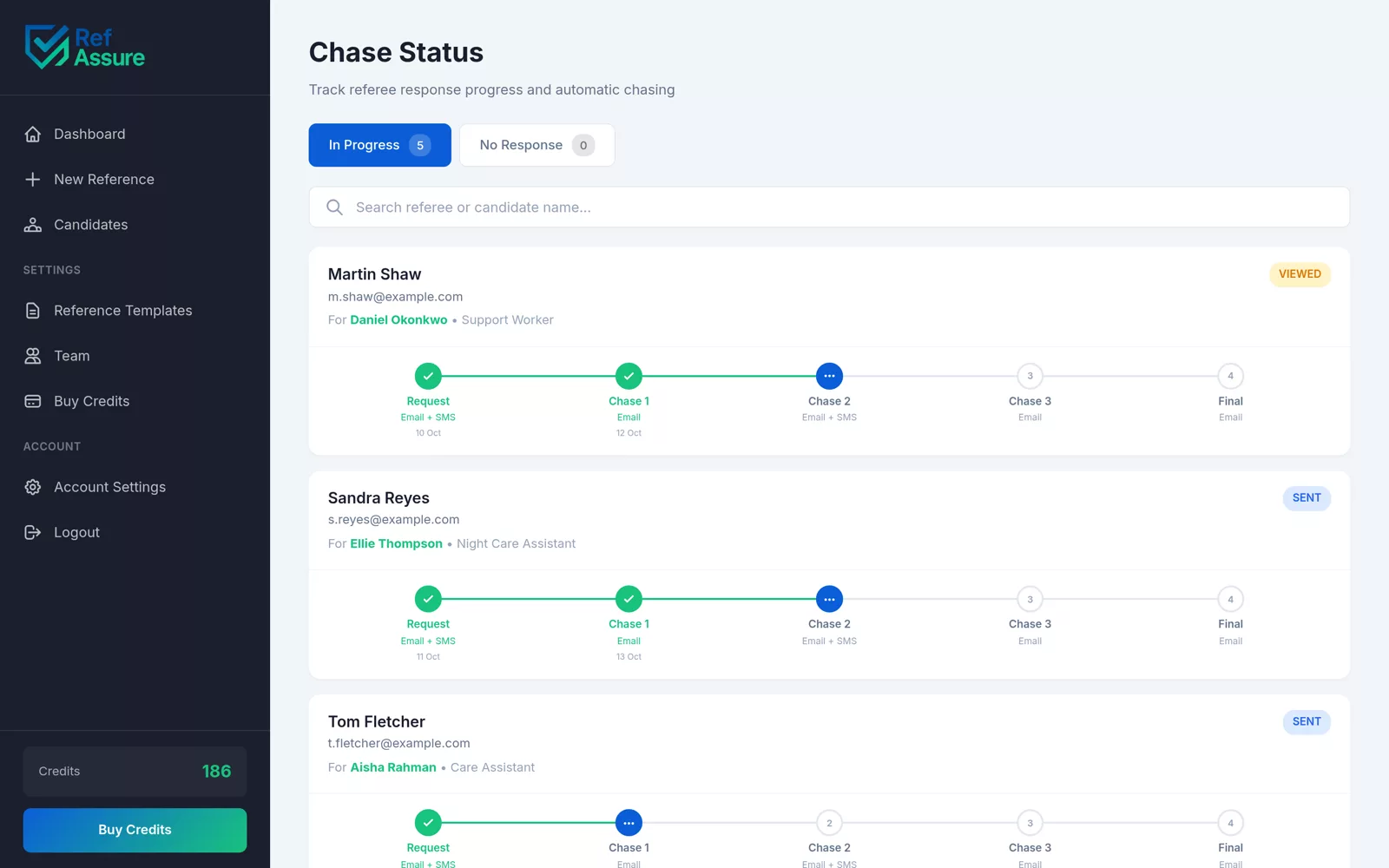
Most referees mean to reply. They just forget. RefAssure reminds them for you, by email and text, until they do.
- 5 emails and up to 2 texts over 12 days, stopping the moment the referee submits
- Bounced requests flagged within minutes, so you can add a new referee
- Told after day 12 if a referee has not replied, so you can add another
- Median turnaround of about 23 hours, with half back within a day
Ready to show an inspector.
When CQC or a local authority asks how you recruited someone, the answer is one PDF, not a hunt through inboxes.
| What you need to show | Chasing by hand | With RefAssure |
|---|---|---|
| Candidate consent | Often verbal, rarely recorded | Collected online with a signature before any referee is contacted |
| Evidence of conduct | Phone notes or loose emails | Written answers to your questions, signed by the referee |
| Who asked, and when | Hard to prove | Timestamps for every request, reminder and response |
| Referees who never reply | Chased when someone remembers | Reminded automatically, and you are told when to add another |
| Agency and bank staff files | Spread across consultants | One account, unlimited team members, shared credits |
| Where the data lives | Personal inboxes | Hosted in the UK |
Care reference questions, answered.
More in the full FAQs.
What references does CQC require?
CQC does not prescribe a reference form. Under Regulation 19 and Schedule 3, registered providers must hold satisfactory evidence of conduct in previous employment in health or social care, or with children or vulnerable adults, and verify as far as reasonably practicable why that employment ended. References are the usual way to get that evidence in writing.
How many references do care workers need?
CQC does not set a number. Many care providers ask for two, including the most recent employer and the most recent care employer if that is different. Set your number in your recruitment policy, then apply it the same way for everyone.
Does the last employer have to give a reference for care work?
Usually not. In the UK most employers have no legal duty to give a reference, and some confirm just dates and job title. If a previous care employer will not answer, record what you asked and when, then seek other evidence of conduct, such as another referee from that period. RefAssure keeps the timestamped record for you.
How far back should care references go?
Schedule 3 asks for a full employment history with a written explanation of any gaps, plus evidence of conduct in previous care roles. CQC does not fix a number of years for references, so cover the roles your policy asks for and make sure the reason employment ended is verified for any job working with children or vulnerable adults.
Can an employer refuse to give a reference?
Yes, in most cases. Unless a contract or a regulator requires one, an employer can decline, or give a short factual reference. If that happens, note it on file and ask the candidate for another referee who can speak to their conduct.
Can a care worker start before references come back?
CQC guidance says the Schedule 3 information must be confirmed before someone is employed, so plan references into your timeline before the start date. RefAssure helps by chasing referees automatically: the median time to a completed reference is about 23 hours.
Does RefAssure have a CQC reference template?
There is no built-in CQC template. You add the questions your service expects to your own template once, or upload the form you already use and RefAssure turns it into a template in about 20 seconds.
How much do care references cost with RefAssure?
Your first reference is free. After that a reference costs 99p on the 10 pack, falling to 80p on the 250 pack. No monthly fee, no contract, no VAT added, and credits never expire. See pricing.
Related guides
Care references, without the chasing.
Your first reference is free. Add a care worker, press send, and RefAssure does the rest.