
RPO recruitment: how reference checking works
What recruitment process outsourcing is, how the models differ, and how to keep references consistent when you hire for several clients.

What is RPO recruitment?
RPO recruitment, or recruitment process outsourcing, is when an employer hands all or part of its permanent hiring to an external provider. The RPO acts as an extension of the in-house team, often under the client's brand, and can run sourcing, screening, offers and pre-employment checks. References are part of that. RefAssure gives each one consent, automatic chasing and a signed PDF.
How does RPO recruitment work?
In a traditional agency relationship, an employer pays a fee for each person placed. In RPO, the provider takes responsibility for the hiring process itself, usually under a longer-term contract with fees tied to the service rather than to individual placements. The provider's recruiters often sit with the client, use its systems and email addresses, and speak to candidates in its name.
Common RPO models
- End-to-end RPO. The provider runs all or most permanent hiring, from workforce planning to the new starter's first day.
- Project RPO. A defined campaign, such as opening a new site or a seasonal graduate intake.
- Selective RPO. One part of the process, such as sourcing, assessment or pre-employment checks.
- Recruiter on demand. Embedded recruiters supplied for a period, paid by time rather than hires.
RPO vs MSP
RPO covers permanent hiring. A managed service provider covers contingent workers such as temps and contractors. Some providers offer both as a combined total talent programme. See MSP recruitment.
Where references sit
When pre-employment checks are in scope, the RPO collects references on the client's behalf and to the client's standard. The client stays the employer and keeps responsibility for the hiring decision, so it will want to see consistent, dated evidence for every hire.
Why RPO references need a standard.
Several clients, several recruiters, one reputation.
Consistency
Every candidate for a client gets the same questions, whichever recruiter sends them.
Client-specific questions
Each client has its own policy on what references must cover.
Time to hire
References are often the last step before a start date, so slow chasing delays the whole hire.
Evidence for review
Clients and their auditors ask to see how checks were done.

A template for each client.
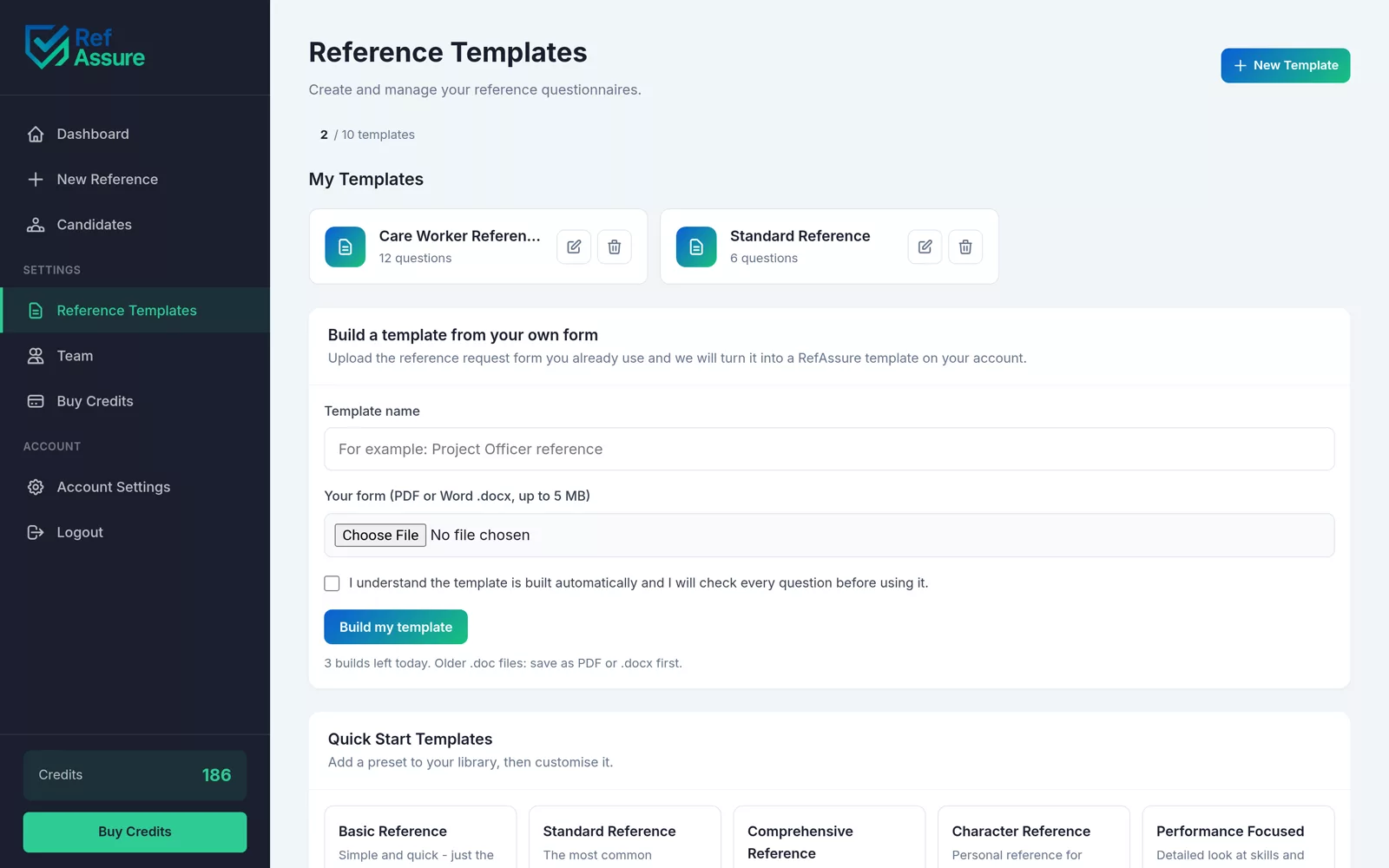
Upload a client's own reference form as a PDF or Word file and RefAssure turns it into a template in about 20 seconds. You check it before using it.
- Up to 10 templates per account, up to 25 questions each
- Short text, paragraph, yes or no, 1 to 10 rating, date and date range questions
- Unlimited recruiters sharing one pool of credits
- A signed PDF with a full timeline for every reference
Chasing that does not hold up the offer.
5 emails and up to 2 texts over 12 days, stopping the moment the referee replies. If a referee is still silent after day 12, you are told so you can add another.
Setting up references for a new RPO client
The start of a new RPO contract is the easiest time to get references right. A short checklist during onboarding saves arguments later.
- Agree the standard in writing. How many references, covering what period, from whom, and whether a current employer can be contacted before an offer.
- Agree what happens when references are poor or missing. Who makes the call, and whether a conditional offer can proceed.
- Agree sector rules. If the client is in care, education or healthcare, its regulator's expectations shape the questions. See safer recruitment reference checks for schools and CQC reference checks for care.
- Agree where evidence lives. Whether you hand over each signed PDF, upload it to the client's system or keep it for an agreed period under your data processing terms.
Then build the client's template once, and every recruiter on the account uses it from day one.
Recruiter by recruiter vs RefAssure.
| By hand | With RefAssure | |
|---|---|---|
| Questions | Each recruiter's own version | The client's template, every time |
| Chasing | Whenever someone remembers | 5 emails and up to 2 texts over 12 days |
| Consent | Assumed from the application | Signed online before referees are contacted |
| Evidence | Scattered across inboxes | One signed, timestamped PDF per reference |
| Cost | Recruiter hours on admin | From 80p per reference, no monthly fee |
RPO recruitment questions
More in the full FAQs.
What does RPO stand for?
Recruitment process outsourcing. An employer transfers all or part of its permanent recruitment to an external provider that works as an extension of its team.
Is an RPO the same as a recruitment agency?
No. An agency usually fills individual roles for a fee per placement. An RPO takes on the hiring process itself over a longer contract, often working under the client's brand.
Do RPO providers carry out reference checks?
Often, when pre-employment checks are part of the contract. The RPO checks to the client's standard, and the client remains the employer. See pre-employment checks.
Can references go out under the client's name?
RefAssure sends requests from your account. Name the client in your template and reference request so referees know who is asking. See reference request email.
How quickly do references come back?
Across 229 completed references the median was about 23 hours, and half came back within 24 hours. 4 in 10 completed after an automatic reminder.
What does RefAssure cost for an RPO team?
Credits cost from 99p down to 80p each, with no per-user fee, no monthly fee and no VAT added. Team members are unlimited. See pricing.
Related guides
One standard across every client.
Your first reference is free. Two minutes to send, and RefAssure does the rest.