
How to spot fake employment references
Most fake references share the same tells. Here are the red flags, the checks that catch them, and where RefAssure helps.
How do you spot fake references?
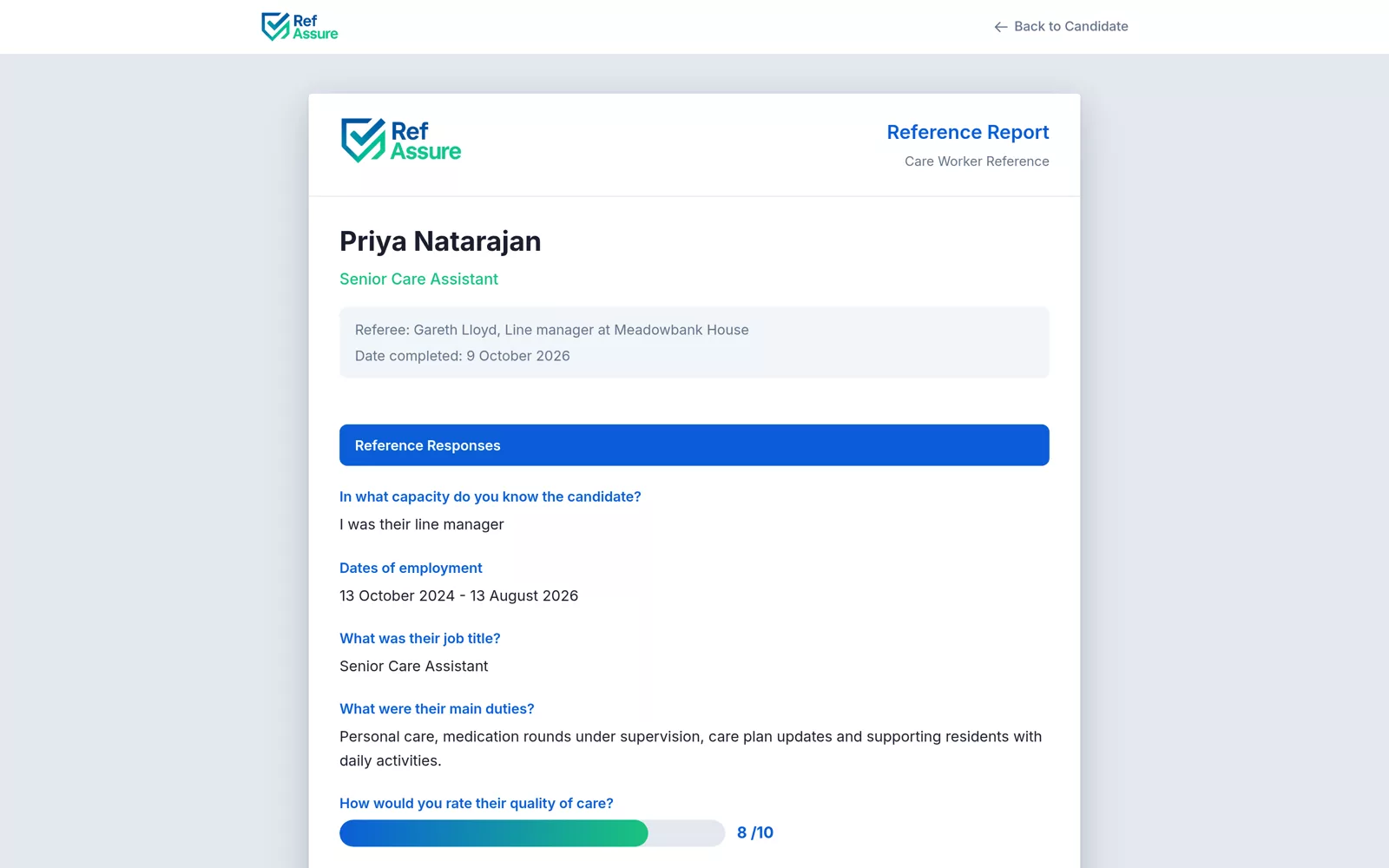
Fake references usually come from a friend posing as a manager. Warning signs include a personal email for a company referee, a mobile number with no switchboard, a company you cannot find on Companies House, and praise with no detail. Check the referee independently, compare dates with the CV, and keep a signed record. RefAssure shows the referee's email, job title and company on every signed report.
Six red flags worth a second look.
None of these proves a reference is fake. Each one is a reason to check a little harder before you rely on it.
Personal email for a work referee
A line manager at an established firm writing from a free webmail address is worth querying. Ask why the company address is not being used.
A mobile and no switchboard
If the sole contact is a mobile number and you cannot find a main line for the business, confirm the referee another way before you rely on the answers.
A company you cannot find
Search Companies House and the web. A business with no trading history, no website or a very recent incorporation date deserves a closer look.
Dates that do not match
Compare employment dates, job title and reason for leaving with the CV. Small differences happen. Large mismatches need a conversation with the candidate.
Glowing but vague
Real managers remember specifics. Lots of praise with no examples, no detail on duties and top marks on every rating can mean the referee barely knows the work.
The candidate controls contact
Be wary if the candidate insists on passing messages to the referee for you, or the referee gets in touch before you have asked.
How do you check a reference is genuine?
A fake reference check does not need special tools. It needs a few minutes of independent checking before you send the request, and a careful read when the answers come back.
Find the company yourself
Look the employer up on Companies House and find its website and main phone number on your own, rather than using contact details from the CV. A quick call to confirm the referee works there, or did, settles most doubts.
Match the email to the employer
A referee at a company with its own website will usually have an email address on that domain. If the address is on a different domain or a free webmail service, ask the candidate why. There are good reasons, such as a small business that uses webmail or a manager who has since left, but you should know the reason.
Ask for HR when you need facts
For dates, job title and reason for leaving, an HR or payroll contact is harder to fake than a named friend. Many larger employers will confirm dates and job title and nothing more, which still lets you verify the employment history.
Explore gaps and overlaps
Compare the reference with the CV and the application form. In regulated work, guidance expects you to explore gaps in employment history, so ask about them at interview. Our guides to employment history checks and safer recruitment reference checks cover this in more detail.
Is it illegal to give a fake reference?
Knowingly supplying a false reference, or lying about past employment to get a job, can amount to fraud by false representation under the Fraud Act 2006. An employer may also treat it as gross misconduct if it comes to light after someone starts. If you suspect fraud, follow your own policy and take advice before acting on an individual case.

Every detail on one signed report.
RefAssure does not decide whether a referee is genuine. It puts the facts in front of you and records every step, so your own checks are quick.
- The referee's email, job title and company sit together on the report, so a mismatched domain stands out
- Made-up or mistyped addresses bounce, and most bounced requests are flagged within minutes
- Referees answer and sign through a unique secure link sent to the address you entered
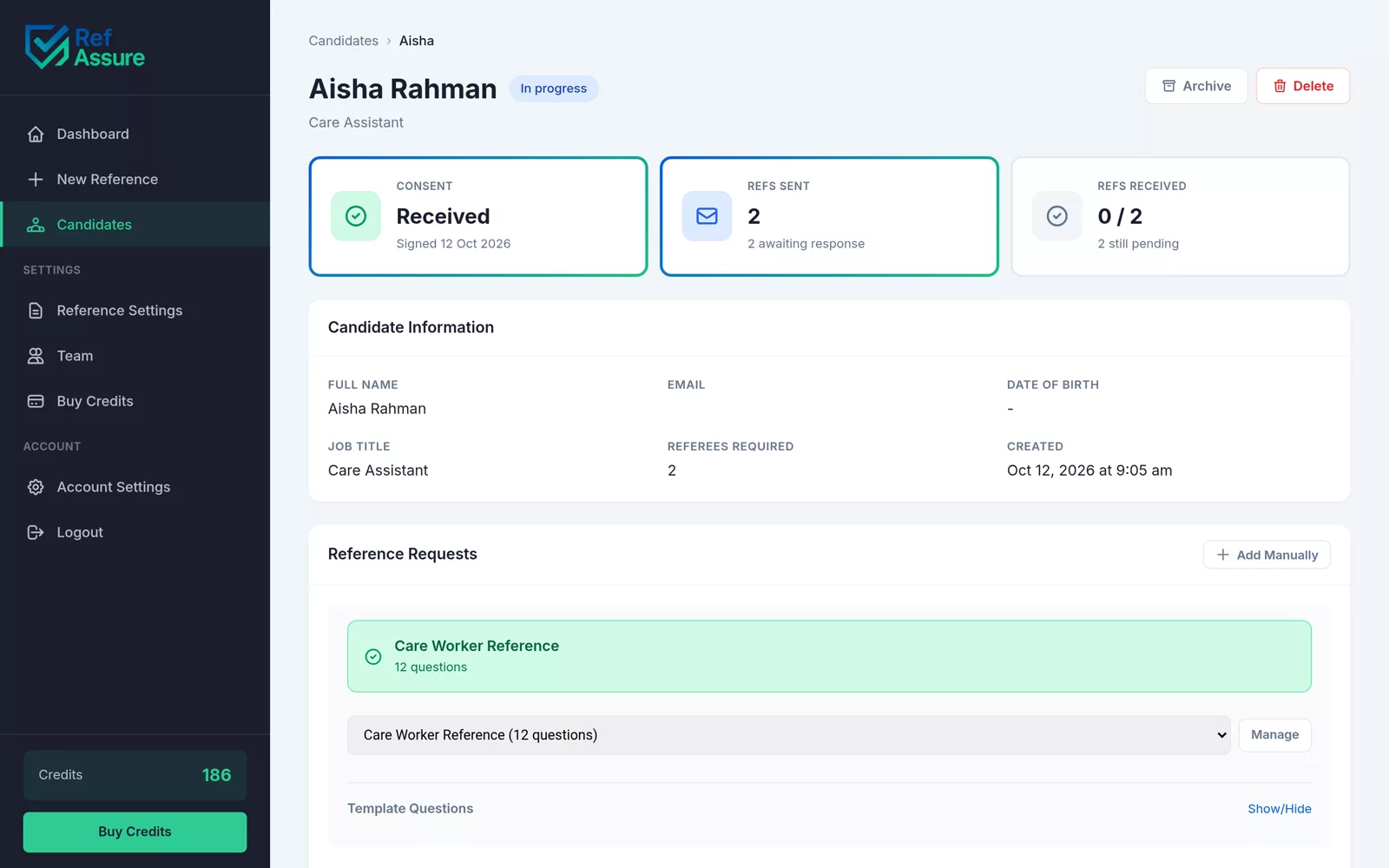
- Candidate consent, each request, every reminder and completion are timestamped in the PDF audit trail
A simple routine for every hire.
Collect two referees
Ask for the most recent employer and a line manager, with work email addresses and a mobile where possible.
Look before you send
Check each company exists and each email domain matches it. Query anything odd with the candidate first.
Send and let it chase
RefAssure collects signed consent, then sends and chases: 5 emails and up to 2 texts over 12 days.
Read the answers critically
Compare dates, duties and ratings with the CV and interview. Follow up anything that does not fit.
Fake reference questions
More in the full FAQs.
What counts as a fake reference?
A reference written by someone other than the person it claims to come from, or one that misstates the facts. Common examples are a friend posing as a manager, invented employment dates and a made-up company. Some websites openly sell fictional employers and referees, so a reference that looks polished is not proof on its own.
Is it illegal to give a fake reference in the UK?
It can be. Knowingly giving false information to obtain a job can amount to fraud by false representation under the Fraud Act 2006, and it may be treated as gross misconduct by the employer. Take advice on any individual case before you act.
Can a candidate fill in their own reference on RefAssure?
The request goes to the email address supplied for the referee. If a candidate supplies an address they control, they could answer it themselves. That is why checking the referee's company and email domain before you send matters, and why the report shows the address used next to the stated employer.
Should I accept a reference from a personal email address?
Not automatically, but do not reject it out of hand either. Some small employers genuinely use webmail and some referees have moved on. Verify the person another way, for example by calling the company, and note what you checked.
Does RefAssure check whether a referee is genuine?
No tool can promise that. RefAssure collects consent, sends and chases the request, flags bounced addresses and gives you a signed PDF with the referee's details and timestamps, so your own checks are quick and on record. See how it works.
What should I do if I think a reference is fake?
Pause the decision, ask the candidate about the discrepancy and request another referee, ideally an HR contact. In RefAssure you can add another referee to the same candidate. Follow your own policy before acting on suspected fraud.
Do references confirm right to work or criminal records?
No. References cover employment history, conduct and suitability. Right to work and DBS checks are separate checks with their own official processes: see our guides to right to work checks and DBS checks.
Related guides
Make every reference a signed record.
Your first reference is free. Consent, chasing and a signed PDF, from 80p after that.