
Is a recruitment agency liable if a reference check is missed?
It can be. What decides it is usually less about the placement going wrong and more about what you can prove you did beforehand.

When is an agency liable for a missed reference check?
Agency reference liability usually arises in three ways: a breach of the Conduct of Employment Agencies and Employment Businesses Regulations 2003, which Regulation 30 makes actionable where it causes damage; a breach of your client contract; or telling a client checks were done when they were not. Written, dated evidence of consent, requests and replies is your strongest protection. RefAssure produces it for every candidate.
Where agency reference liability comes from
This is general information, not legal advice. For a specific situation, speak to a solicitor or your trade body.
1. The Conduct Regulations
Before introducing or supplying a work-seeker, Regulation 19 requires you to confirm their identity and that they have the experience, training and qualifications the client considers necessary. Where the role involves working with, caring for or attending vulnerable people, Regulation 22 adds two references from people who are not relatives and who agree the reference can be shared with the client. If you cannot fully get them, you must tell the client what reasonably practicable steps you took. Regulation 30 says a breach that causes damage can found a civil claim. Enforcement of agency standards now sits with the Fair Work Agency.
2. Your client contract
Most terms of business and framework agreements include a promise that you will vet workers in a stated way, often with an indemnity. If a client can show you skipped a step you promised, the contract is usually the quickest route to a claim, whatever the regulations say.
3. What you tell the client
Saying a candidate is "fully referenced" when one referee never replied is a statement a client may rely on. If it turns out to be untrue and they suffer loss, that statement itself can create exposure. Report what you actually hold.
What about the referee?
Referees owe a duty of care to the person they write about, and a reference must be true, accurate and fair. That protects candidates. It does not move your own duty to check onto the referee.
What you can prove, side by side.
| Email and phone notes | RefAssure record | |
|---|---|---|
| Candidate consent | Assumed at registration | Signed online before any referee is contacted |
| When requests went out | Somewhere in a sent folder | Timestamped in the PDF |
| Chasing | Depends on the consultant | 5 emails and up to 2 texts over 12 days |
| Referee identity | Free text email reply | Unique secure link, signed by the referee |
| Unanswered referees | Easy to miss | You are told after day 12 so you can add another |
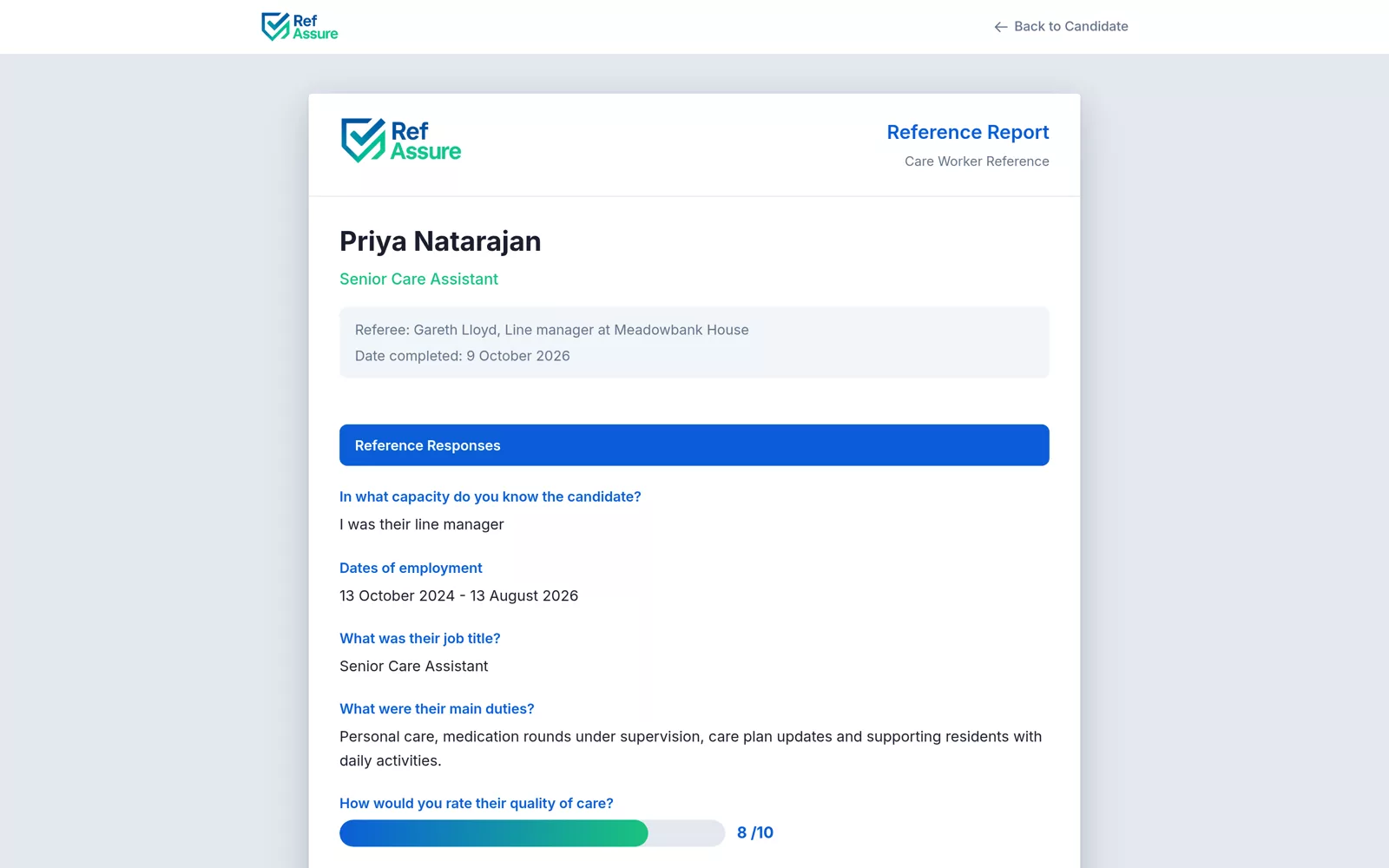
| Retrieval at audit | Search inboxes | One PDF per candidate |

Evidence that builds itself.
Every step is logged as it happens, so the record is there the day a client or inspector asks for it.
- Consent, requests, reminders and completion all timestamped
- Bounced emails flagged, most within minutes
- Replies sent by email instead of the form are captured and forwarded
- Your own reference form, uploaded as PDF or Word, becomes a template
Agency liability questions
More in the full FAQs.
Can an agency be sued over a worker it placed?
Yes, if a client or third party can show the agency breached a duty and that caused loss. Regulation 30 of the Conduct Regulations allows civil claims for breaches that cause damage, and client contracts often add their own remedies.
Do agencies have to take two references?
Regulation 22 requires two references from non-relatives where the role involves vulnerable people. For other roles the duty is to confirm experience and qualifications, and most client contracts set references as the standard way to do it. See the Conduct Regulations guide.
What if a referee never replies?
Keep evidence of every attempt and tell the client what you hold. RefAssure chases with 5 emails and up to 2 texts over 12 days, then tells you so you can add another referee.
Does a reference check protect the agency completely?
No process removes all risk. What a clear record does is show you took reasonable steps, which is what regulators, clients and courts tend to look at.
How long should agencies keep reference records?
Set a period in your retention policy and privacy notice that matches your contracts and the claims window you are worried about. Our guide to candidate consent covers the data protection side.
Who enforces the Conduct Regulations now?
The Employment Agency Standards Inspectorate's work moved into the Fair Work Agency in April 2026. Check GOV.UK for current guidance.
Related guides
Have the evidence before you need it.
Your first reference is free. Every step is logged in a signed PDF.