
Safer recruitment policy: free template for schools and care
A plain-English policy outline you can copy, adapt and adopt. Each section says what to write and which guidance it follows.

What should a safer recruitment policy include?
A safer recruitment policy should set out your commitment to safeguarding, who is responsible, how roles are advertised, how applications and shortlisting work, how references and pre-employment checks are taken up, how interviews are run, what records are kept and when the policy is reviewed. Schools follow KCSIE Part three; care providers follow CQC Regulation 19 and Schedule 3.
Why you need a written policy.
A written policy gives your panel one agreed process and shows an inspector how you recruit. Which guidance applies depends on your setting.
Schools and colleges
KCSIE asks governing bodies and proprietors to have safer recruitment policies in line with Part three, in place, embedded and effective. Recruiters should have safer recruitment training, and maintained schools need at least one trained person on each interview panel.
Care and health providers
CQC Regulation 19 requires effective recruitment procedures. Schedule 3 lists what you must hold, including evidence of conduct in previous relevant roles and a full employment history with gaps explained.
Early years settings
The EYFS framework says safeguarding policies must include procedures to check the suitability of new recruits. See our early years guide.
Safer recruitment policy template
Copy these headings into your own document and replace the guidance in each section with your own wording.
1. Purpose and scope
State that the policy covers the recruitment of all staff, volunteers and, where relevant, agency and contract workers. Name the guidance you follow: KCSIE for schools and colleges, or CQC Regulation 19 for registered care and health services.
2. Commitment statement
A short statement that the organisation is committed to safeguarding and promoting the welfare of children or adults at risk, and expects all staff to share that commitment. Use the same wording in adverts.
3. Roles and responsibilities
Who approves posts, who sits on panels, who holds safer recruitment training and when it is refreshed, and who keeps the records (for schools, the single central record).
4. Advert and job description
Include the safeguarding commitment, the safeguarding responsibilities of the post and whether it is exempt from the Rehabilitation of Offenders Act 1974.
5. Applications
Use an application form, not a CV alone. Ask for full employment history with reasons for gaps, present or last employment and reason for leaving, qualifications and referee details. For roles in regulated activity with children, state that it is an offence to apply if barred.
6. Shortlisting and declarations
Shortlist against the person specification by more than one person. Ask shortlisted candidates for a self-declaration. Schools should tell shortlisted candidates that online searches may be done as part of due diligence.
7. References
Request references directly from referees, before interview where possible. Do not accept open references or rely on the candidate to obtain them. Ask about suitability to work with children or adults at risk, disciplinary matters and the reason for leaving. Compare references with the application and resolve concerns before confirming an appointment.
8. Interview
Explore gaps, discrepancies and any concerns raised by references. Include at least one question on safeguarding values.
9. Pre-appointment checks
List the checks for each type of role: identity, enhanced DBS (with barred list where the role needs it), right to work, qualifications and professional registration, overseas checks where relevant, and mental and physical fitness for the role. Schools add prohibition checks for teachers.
10. Conditional offer, induction and probation
Offers are conditional on satisfactory checks. Cover induction, safeguarding training and probation reviews.
11. Records and retention
What you record, where it is stored, who can see it and how long it is kept, in line with UK GDPR.
12. Review
Who reviews the policy and how often. Most organisations review it every year and whenever the guidance changes.

Section 7, handled for you.
References are where policies tend to slip in practice. RefAssure collects them the way your policy describes, and keeps the evidence.
- Requests go straight to the referee by email, never via the candidate
- Candidate consent collected online, with signature, before anyone is contacted
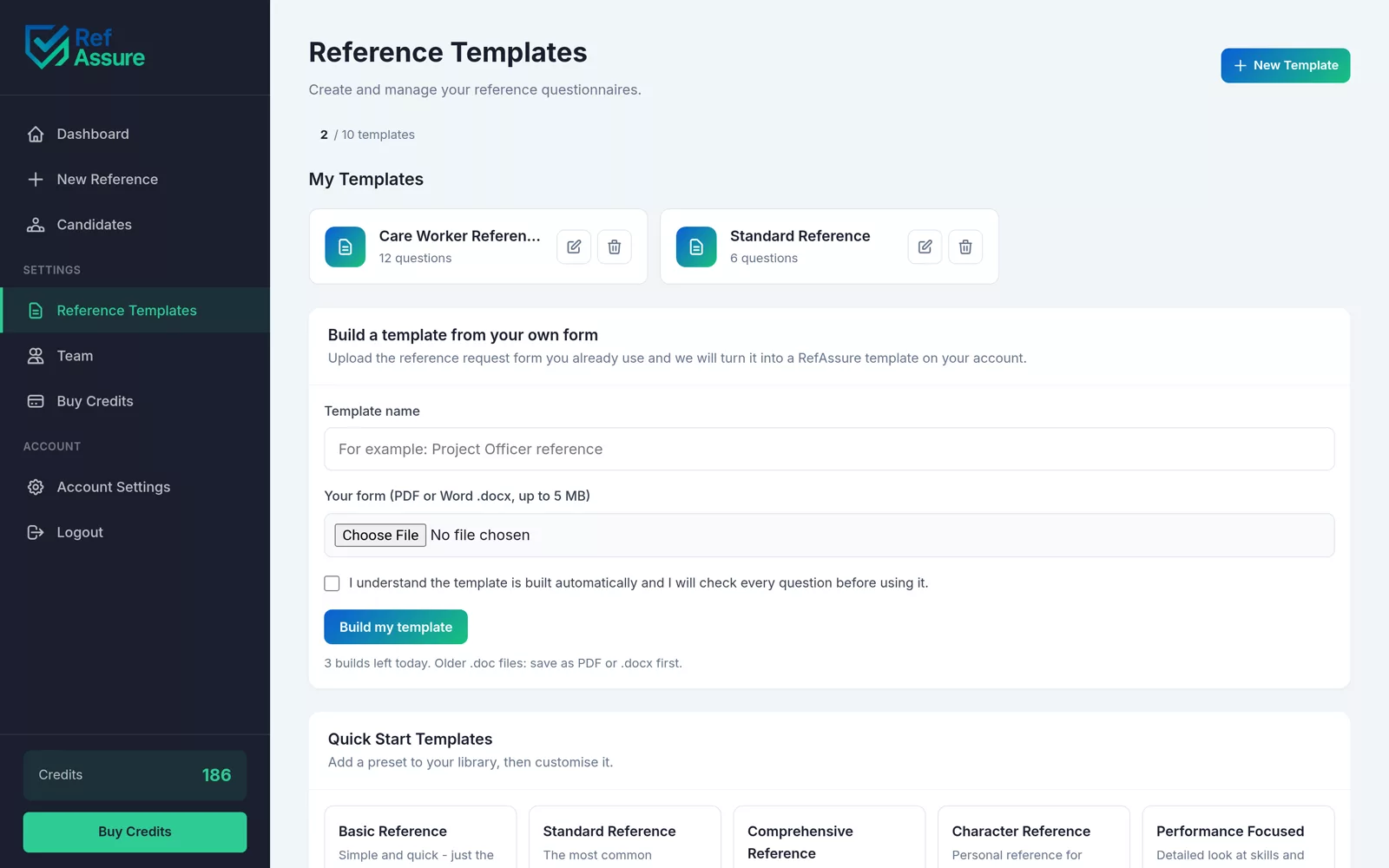
- Add your safeguarding and disciplinary questions to your template once
- Signed PDF with timestamps for consent, requests, reminders and completion
No more chasing referees by hand.
5 emails and up to 2 texts over 12 days, stopping the moment the referee replies.
Safer recruitment policy questions
More in the full FAQs.
Is a safer recruitment policy a legal requirement?
For schools, KCSIE is statutory guidance and expects governing bodies and proprietors to have safer recruitment policies in line with Part three. Care providers must meet CQC Regulation 19, which requires effective recruitment procedures. A written policy is the clearest way to show you have them.
Where are the official safer recruitment guidelines?
For schools and colleges in England, Part three of Keeping children safe in education on GOV.UK. For care, CQC guidance on Regulation 19 and Schedule 3. For early years, the EYFS statutory framework. See our safer recruitment checklist for a working list.
How often should we review the policy?
Most organisations review it every year, and straight away when the guidance changes. KCSIE is usually updated each September, so schools often review over the summer.
Can I download this as a Word file?
Not at the moment. Copy the headings and guidance from this page into your own document. If you need a reference request form, our free employment reference template is ready to use.
What should the references section say?
That references are requested directly from referees, ideally before interview, that open references are not accepted, and that concerns are resolved before appointment. Our safeguarding reference questions page has question wording you can use.
Does RefAssure do the other checks in the policy?
No. RefAssure collects references and employment history. DBS checks, right to work checks and registration checks are done through the official services. See the DBS checks guide and right to work checks.
Related guides
Put your policy into practice.
Your first reference is free. Two minutes to send, and RefAssure does the chasing.