
What are pre-employment checks, and how long do they take?
The checks UK employers run between offer and first day, which ones the law requires, and how long each one usually takes.

What are pre-employment checks?
Pre-employment checks are the checks an employer makes before someone starts, to confirm they can legally work and are who they say they are. In the UK they usually include a right to work check, references and employment history, and, for some roles, a DBS check, qualifications, professional registration and a health assessment. Right to work is required for everyone; the rest depend on the role and sector.
The common UK pre-employment checks.
Most roles need two or three of these. Regulated roles need most of them.
Right to work
Required for every employee before they start. Done through Home Office routes. See right to work checks.
References
Previous employers confirm dates, role and conduct. Expected in care, schools and healthcare, and common everywhere.
Criminal record (DBS)
Basic for any role, standard or enhanced for eligible roles. See our DBS checks guide.
Qualifications and registration
Certificates for roles that need them, and register checks for regulated professions such as nurses and doctors.
Health assessment
A health questionnaire or occupational health review, usually after a job offer.
How long do pre-employment checks take in the UK?
| What it confirms | Typical time | |
|---|---|---|
| Right to work | Legal right to work in the UK | Same day with a share code or documents in hand |
| References | History, conduct, suitability | With RefAssure, a median of about 23 hours; half within 24 hours |
| Basic DBS | Unspent convictions | Usually days, can be longer |
| Enhanced DBS | Fuller criminal record, police information, barred lists where eligible | Days to several weeks, depending on police checks |
| Professional registration | Registered and fit to practise | Minutes, using the regulator's online register |
| Occupational health | Fitness for the role, adjustments | Varies by provider |

Which pre-employment checks are a legal requirement?
For every UK employer, one check is a legal duty for every hire: the right to work check, done before the person starts. Since 1 October 2026 the Home Office scheme also covers some arrangements beyond employees, such as workers' contracts and individual subcontractors.
Beyond that, the requirements come from the sector:
- Care. CQC-registered providers must hold the information in Schedule 3 under Regulation 19, including references, a full employment history with gaps explained, and a DBS check. See care worker pre-employment checks.
- Schools. Keeping Children Safe in Education Part 3 sets out safer recruitment checks, including references and enhanced DBS. See school pre-employment checks.
- NHS and healthcare. NHS Employers publishes the NHS Employment Check Standards. See healthcare pre-employment checks.
- Government and security work. BPSS and BS 7858 set their own checks. See BPSS checks and BS7858 screening.
Outside regulated sectors, references and other checks are your choice. They are still good practice, and many employers make offers conditional on them.
Health questions and the Equality Act
The Equality Act 2010 limits health and disability questions before a job offer, with some exceptions, such as making adjustments for the interview. That is why health questionnaires and occupational health usually come after a conditional offer.
Data protection
Checks involve personal data, and criminal record data needs extra care. Tell candidates what you will check and why, collect just what the role needs, and keep it securely. The ICO publishes guidance for employers.
The slowest check, made faster.
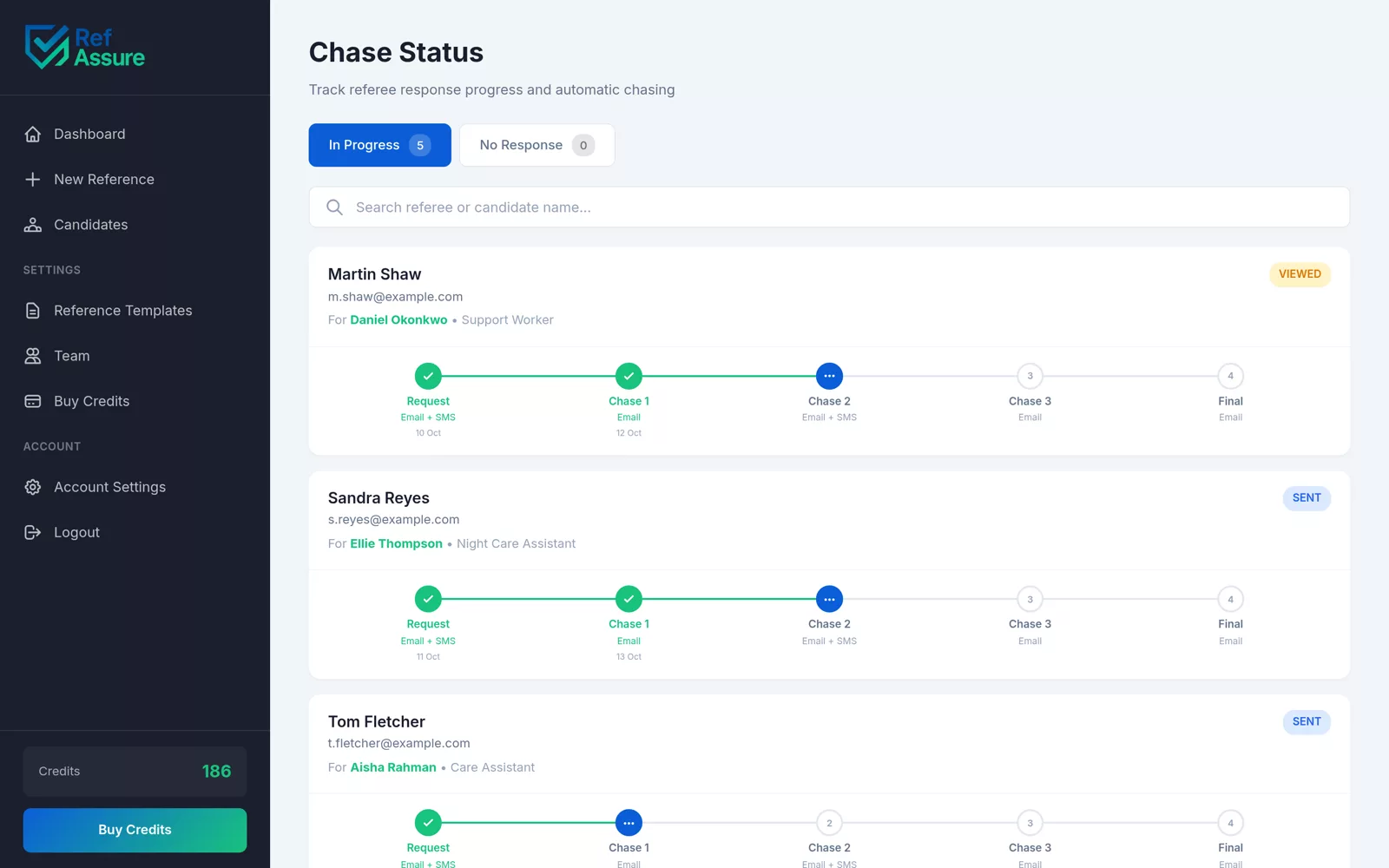
References depend on someone else replying. RefAssure sends the request at offer and chases until they do.
- Candidate consent collected online, with signature, before referees are contacted
- 5 emails and up to 2 texts over 12 days, stopping when the referee replies
- 4 in 10 references came back after an automatic reminder
- Signed PDF with a full audit trail for the file
Pre-employment check questions
More in the full FAQs.
How long do pre-employment checks take in the UK?
It depends on which checks the role needs. Right to work can be done the same day. References depend on referees replying; with RefAssure the median was about 23 hours. Enhanced DBS checks can take longer because they may involve police forces.
Can I start work before pre-employment checks are complete?
Not before the right to work check. For other checks it depends on the sector: care, schools and healthcare expect key checks first. Elsewhere it is the employer's decision, ideally under a written policy.
Can a job offer be withdrawn after failed checks?
If the offer was made conditional on satisfactory checks, the employer can usually withdraw it if they are not met. Acas has guidance, and employers should act fairly and avoid discrimination.
Are pre-employment checks done before or after the offer?
Usually after a conditional offer. References are commonly requested at that point, and health questions generally have to wait until after an offer.
What happens if a reference is bad?
Read it in context, check facts with the candidate if appropriate, and decide fairly. Our guide to fake references covers warning signs.
Does RefAssure run all pre-employment checks?
No. RefAssure collects references and employment history. Right to work, DBS, registration and health checks are done through their own services. Your first reference is free; see pricing.
Related guides
Get the references back first.
Your first reference is free. Send it at offer and RefAssure chases the referee.